
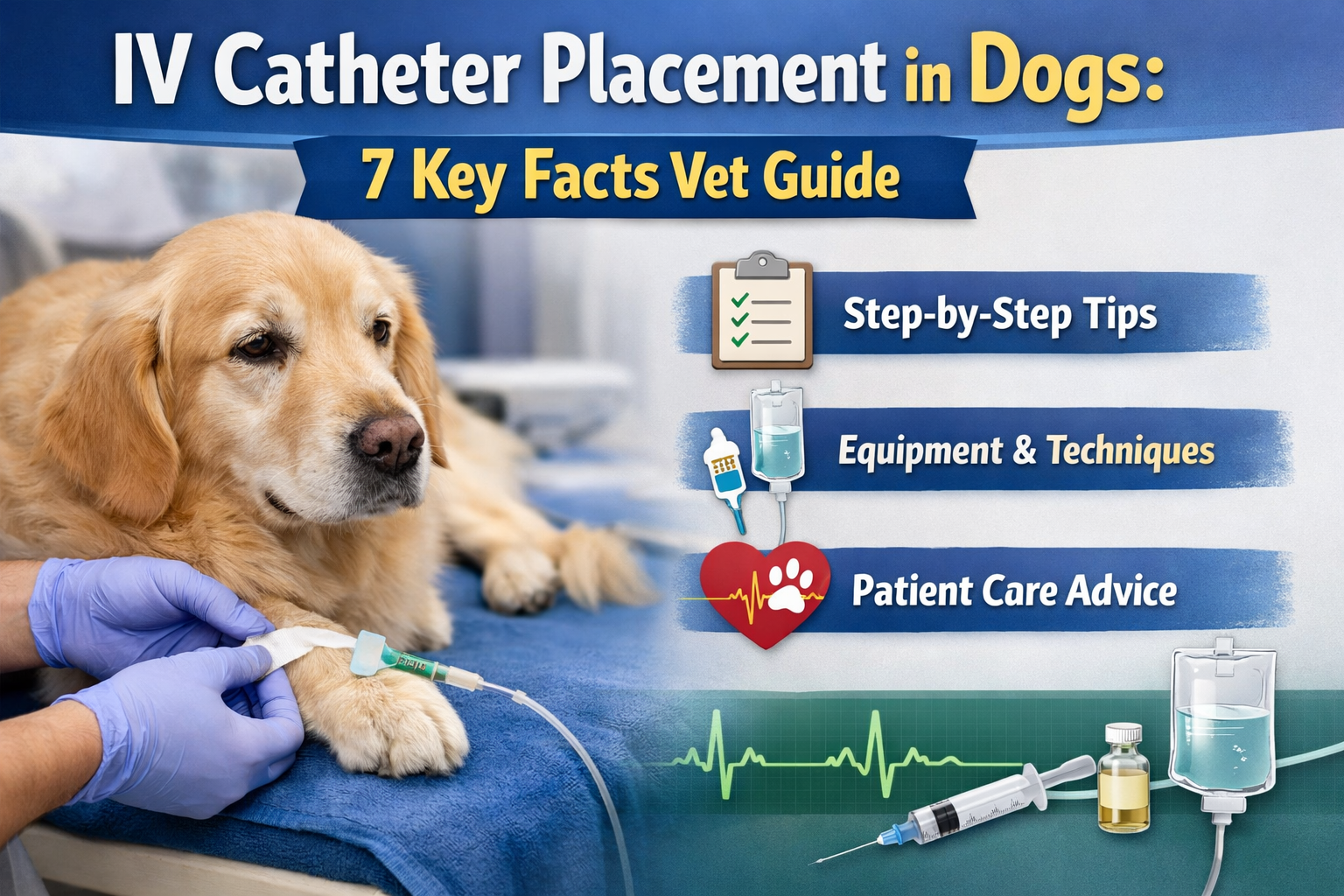

Intravenous (IV) catheter placement in dogs is a routine but highly skilled veterinary procedure used in clinics, emergency hospitals, and surgical settings. It allows vets to deliver fluids, medications, and anaesthesia directly into the bloodstream for fast and reliable effect.
While many pet owners search for information about how it works, it’s important to understand that IV catheter placement is a clinical procedure that should only ever be performed by trained veterinary professionals. Attempting it without training can cause pain, infection, tissue damage, or serious complications.
This guide explains everything pet owners commonly want to know in a safe, educational way—covering how vets use IV catheters, where they are placed, what can go wrong, and how to recognise if something isn’t right.
Read also: Why Is My Dog Eating Poop? Causes, Behaviour & How to Stop It – Paws and Pet Hub
What is an IV catheter used for in dogs?
An IV catheter is a small, flexible tube placed into a vein to allow direct access to the bloodstream. In veterinary medicine, it is commonly used for:
- Administering anaesthesia during surgery
- Delivering emergency fluids in dehydrated or shock patients
- Giving fast-acting medications
- Supporting critically ill dogs in hospital care
- Blood sampling in some cases
Because medications go directly into circulation, the effects are usually immediate and highly controlled. IV catheter placement in dogs is essential whilst they are admitted at the hospital.
Where do vets put IVs on dogs?
One of the most frequently asked questions is: where do vets put IVs on dogs?
IV catheter placement in dogs are in veins that can be:
- Easily accessible
- Relatively stable
- Safe for repeated access
- Suitable for the size of the dog
Common sites include:
- The front leg (cephalic vein)
- The back leg (saphenous vein)
- Occasionally the jugular vein in the neck (mainly in hospital settings)
The choice depends on the dog’s condition, temperament, size, and the type of treatment required.
Which vein is most commonly used for IV catheter placement in dogs?
Another common search query is: which vein is most commonly used for IV catheter placement in dogs?
In general veterinary practice, the cephalic vein (located on the front leg) is the most commonly used site.
This is because it is:
- Easy to access in most dogs
- Relatively stable during movement
- Suitable for short and long procedures
- Convenient for hospital monitoring
The lateral saphenous vein (on the hind leg) is also frequently used, especially if the front legs are not suitable.
In more advanced or emergency care situations, vets may use the jugular vein, which allows for larger fluid administration and central access.
Read also: 7 Important Types of Bones in Animals: A Full Guide
Where is the IV injection site on a dog?
Pet owners often ask: where is the IV injection site on a dog?
The IV “site” is not a single fixed location. Instead, it refers to a vein where the catheter is placed. These are usually:
- Inside or along the front legs
- On the outer side of the back legs
- In the neck region (less commonly visible to owners)
You may notice a small bandage or tape wrap once the catheter is placed. This is used to secure it and protect the site.
Is it hard to give a dog an IV?: IV catheter placement in dogs
Yes—IV catheter placement in dogs can be challenging, even for experienced veterinary professionals.
Several factors affect difficulty:
- Dog size (very small or very large dogs can be harder)
- Dehydration (veins become harder to locate)
- Shock or low blood pressure
- Movement or anxiety
- Previous IV attempts or scar tissue
- Coat thickness or skin condition
This is why restraint techniques, training, and experience are essential in veterinary practice. In many cases, more than one attempt may be required, but vets are trained to minimise stress and discomfort.
How to find a vein for an IV in a dog
A very common search is: how to find a vein for an IV in a dog
In veterinary settings, trained professionals identify veins through:
- Visual assessment (looking for visible vessels)
- Palpation (feeling for a soft, springy vessel)
- Positioning techniques to improve vein visibility
- Clinical judgement based on hydration and circulation
However, it is important to stress that vein location and catheter placement require formal veterinary training and sterile technique. Attempting to locate or access veins without training can cause harm, including bruising, vessel damage, or infection.
What are the common mistakes in IV insertion?
Understanding complications helps pet owners appreciate why this procedure is restricted to professionals.
Some common mistakes in IV insertion (in a clinical context) include:
- Incorrect catheter size selection
- Poor vein stabilisation during insertion
- Inadequate sterilisation of the site
- Multiple failed attempts causing vein trauma
- Incorrect placement outside the vein (infiltration)
- Failure to secure the catheter properly
- Overlooking early signs of swelling or leakage
Veterinary teams are trained to reduce these risks through strict protocols, sterile technique, and monitoring.
How do I tell if an IV was put in wrong?
Pet owners may worry about IV complications and ask: how do I tell if an IV was put in wrong?
Signs that an IV catheter may not be functioning correctly include:
- Swelling around the insertion site
- Fluid leaking under the skin
- The dog showing discomfort when the area is touched
- Reduced flow of fluids through the IV line
- Cool or firm swelling near the bandage
- Redness or irritation around the site
If any of these signs are noticed, veterinary staff should be alerted immediately. In most clinical environments, IV sites are checked regularly to prevent complications.
What are the risks of IV catheter placement?
Although IV catheters are extremely common and generally safe in veterinary medicine, risks can include:
- Localised infection
- Inflammation of the vein (phlebitis)
- Bruising or haematoma
- Fluid leakage into surrounding tissue
- Catheter blockage or displacement
These risks are significantly reduced in clinical environments where sterile technique and monitoring are routine.
Why IV catheters are so important in veterinary care
Despite the risks, IV access is one of the most valuable tools in veterinary medicine. It allows:
- Rapid stabilisation of emergency patients
- Safe delivery of anaesthesia
- Precise fluid therapy control
- Immediate medication effects
In many emergency cases, IV access can be life-saving.
Veterinary safety and professional responsibility
It is important to emphasise that IV catheter placement is a regulated veterinary procedure. Only qualified professionals such as veterinarians and registered veterinary nurses should perform it.
This ensures:
- Animal welfare is protected
- Sterile technique is maintained
- Complications are minimised
- Correct medication dosing is delivered
Pet owners should never attempt IV placement at home or outside a clinical setting.
Final thoughts
IV catheter placement in dogs is a routine but highly skilled procedure that plays a vital role in modern veterinary medicine. While it may look simple when performed by trained professionals, it requires extensive knowledge of anatomy, technique, and sterile practice.
If you are a pet owner, the most important takeaway is this: IV access is safest in a veterinary clinic, where your dog can receive expert care and monitoring throughout the process.
Understanding how it works can help reduce anxiety and build trust in the veterinary process—but the procedure itself should always remain in professional hands.
Read also: IV Catheters for Dogs: What Are They, and How Do You Care For Them? | PetMD



Leave a Reply