

Introduction to Types of Bones in Animals
Understanding the types of bones in animals is fundamental in anatomy, veterinary science, zoology, and animal health. Bones provide structure, protection, movement, and support for all vertebrate species.
From dogs and cats to horses, birds, and livestock, all animals share a common skeletal framework—but the types of bones in animals vary in shape, function, and adaptation depending on species and lifestyle.
This article explores the classification of bones in animals, their structure, and their biological importance in a clear and practical way.
Read also: Kidney Anatomy In Dogs: The Ultimate Vet Nurse Guide
What Are Bones in Animals?
Bones are rigid organs that form the skeleton of vertebrate animals. They are composed of:
- Collagen (flexible protein framework)
- Calcium phosphate (hard mineral matrix)
Together, these components make bones strong yet slightly flexible.
The types of bones in animals are categorised based on their shape and function rather than their chemical composition.
Main Types of Bones in Animals
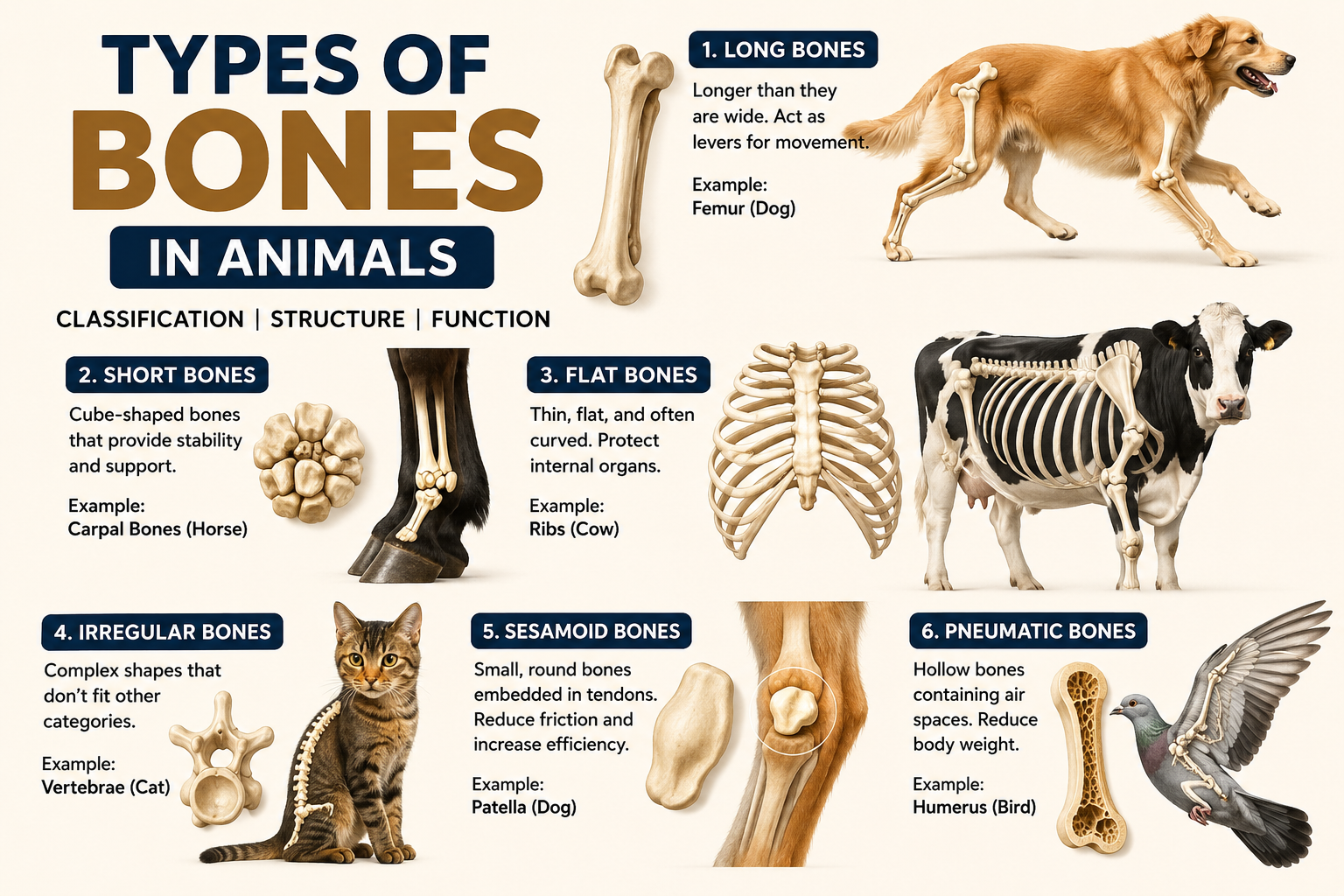
There are six primary categories when studying types of bones in animals:
1. Long Bones
Long bones are characterised by their elongated shape and are primarily responsible for movement.
Examples:
- Femur
- Humerus
- Tibia
- Radius and ulna
Features:
- Long shaft (diaphysis)
- Two expanded ends (epiphyses)
- Contain bone marrow
Function:
- Support body weight
- Enable locomotion
- Act as levers for muscles
Long bones are especially important in fast-moving animals like dogs, horses, and deer.
2. Short Bones
Short bones are roughly cube-shaped and provide stability with limited movement.
Examples:
- Carpal bones (wrist)
- Tarsal bones (ankle)
Features:
- Spongy interior
- Thin compact bone exterior
Function:
- Absorb shock
- Provide stability and support
- Allow small, controlled movements
Short bones are essential in weight-bearing joints.
3. Flat Bones
Flat bones are thin, flattened, and often curved. They are mainly involved in protection.
Examples:
- Skull (cranial bones)
- Ribs
- Scapula
- Pelvis (partially classified)
Features:
- Two layers of compact bone
- Spongy bone (diploë) in between
Function:
- Protect vital organs
- Provide large surface area for muscle attachment
Flat bones are crucial for protecting the brain, heart, and lungs.
4. Irregular Bones
Irregular bones have complex shapes that do not fit into other categories.
Examples:
- Vertebrae
- Sacrum
- Mandible
Features:
- Complex internal structure
- Multiple projections and surfaces
Function:
- Protect the spinal cord
- Support movement and flexibility
- Provide attachment points for muscles
Irregular bones are vital for structural integrity and movement control.
5. Sesamoid Bones
Sesamoid bones are small, round bones embedded within tendons.
Example:
- Patella (kneecap)
Features:
- Develop within tendon tissue
- Vary in number between species
Function:
- Reduce friction
- Protect tendons
- Increase mechanical efficiency of muscles
Sesamoid bones are especially important in high-load joints like the stifle in dogs and horses.
6. Pneumatic Bones
Pneumatic bones contain air spaces connected to the respiratory system.
Examples:
- Birds’ skull
- Humerus (in birds)
- Sternum (in some species)
Features:
- Hollow structure
- Air-filled cavities
Function:
- Reduce body weight for flight
- Maintain strength while decreasing density
These are mainly found in birds and some reptiles, supporting flight adaptation.
Comparison of Types of Bones in Animals
| Bone Type | Shape | Main Function | Examples |
|---|---|---|---|
| Long bones | Elongated | Movement & support | Femur, humerus |
| Short bones | Cube-like | Stability | Carpals, tarsals |
| Flat bones | Thin/flat | Protection | Skull, ribs |
| Irregular bones | Complex | Structural support | Vertebrae |
| Sesamoid bones | Round | Tendon protection | Patella |
| Pneumatic bones | Hollow | Weight reduction | Bird humerus |
Structure of Animal Bones
Regardless of the types of bones in animals, all bones share similar structural components:
1. Compact Bone
Dense outer layer providing strength.
2. Spongy Bone
Light, porous interior containing bone marrow.
3. Bone Marrow
- Red marrow: blood cell production
- Yellow marrow: fat storage
4. Periosteum
Outer membrane that supports growth and repair.
Functions of Bones in Animals
Bones are not just structural—they are biologically active organs.
1. Support
Provide shape and structural integrity.
2. Movement
Work with muscles and joints to enable locomotion.
3. Protection
Shield vital organs like the brain and heart.
4. Blood Cell Production
Red bone marrow produces:
- Red blood cells
- White blood cells
- Platelets
5. Mineral Storage
Store calcium and phosphorus for metabolic use.
Species Differences in Bone Types
Different animals adapt their bone structure based on lifestyle:
Dogs and Cats
- Strong long bones for running and jumping
- Well-developed sesamoid bones
Horses
- Highly specialised long bones for speed and weight bearing
- Reduced limb bone numbers for efficiency
Birds
- Pneumatic bones for flight
- Fusion of multiple bones for strength
Ruminants
- Dense limb bones for standing and grazing endurance
Clinical Relevance in Veterinary Medicine
Understanding the types of bones in animals is essential for diagnosing:
Fractures
Common in long bones due to high mechanical stress.
Arthritis
Often affects joints involving short and sesamoid bones.
Developmental Disorders
Such as angular limb deformities in young animals.
Bone Infections (Osteomyelitis)
Can affect any bone type but often severe in long bones.
Veterinary nurses and clinicians rely heavily on anatomical knowledge for imaging interpretation and surgical planning.
Diagnostic Tools for Bone Evaluation
Veterinary professionals assess bone health using:
Radiography (X-rays)
Best for fractures and alignment issues.
CT Scans
Detailed imaging of complex bone structures.
MRI
Useful for soft tissue and bone marrow evaluation.
Ultrasound
Limited use but helpful in young animals or soft tissue attachments.
Frequently Asked Questions (FAQ)
What are the main types of bones in animals?
The main types are long, short, flat, irregular, sesamoid, and pneumatic bones.
Which bone type is responsible for movement?
Long bones are primarily responsible for movement and locomotion.
What are sesamoid bones in animals?
They are small bones embedded in tendons that reduce friction and improve joint efficiency.
Do all animals have pneumatic bones?
No, pneumatic bones are mainly found in birds and some reptiles.
Why are bones important in animals?
They provide structure, protect organs, enable movement, and support blood cell production.
Conclusion
The types of bones in animals form a fundamental part of vertebrate anatomy, each adapted for specific roles such as movement, protection, and support. Understanding these classifications is essential for veterinary professionals, students, and animal science enthusiasts.
From long bones powering movement to pneumatic bones enabling flight, the skeletal system demonstrates remarkable biological diversity across species.
Useful link: Veterinary Anatomy Guide » Types of bones in animals





Leave a Reply