
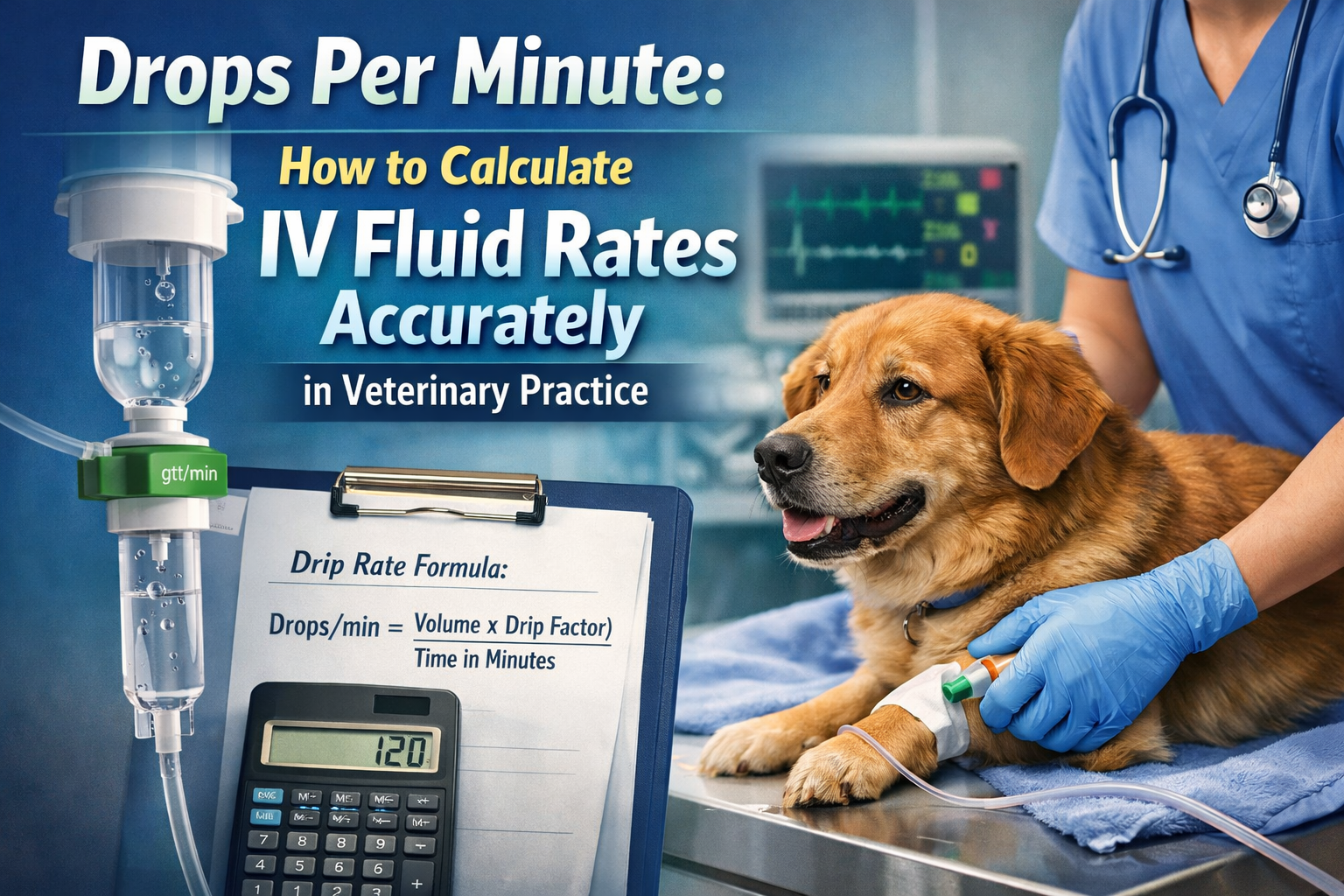

Whether you’re a student veterinary nurse, a newly qualified RVN, or an experienced veterinary professional refreshing your knowledge, understanding drops per minute is an essential clinical skill. Although many veterinary practices now use syringe drivers and infusion pumps, manual fluid administration remains common in emergency situations, field work, and when electronic pumps aren’t available.
Being able to accurately calculate an IV rate drops per minute can help ensure patients receive the correct amount of fluid therapy safely and effectively. In this guide, we’ll explain exactly how to perform a drops per minute calculation, provide worked examples, discuss common mistakes, and share useful tips for improving your confidence.
What Does Drops Per Minute Mean?
Drops per minute (often abbreviated as gtt/min) refers to the number of fluid drops that should pass through an IV giving set every minute to deliver the prescribed volume of fluids over a specified period.
Rather than measuring fluid in millilitres per hour using an infusion pump, you’re manually adjusting the drip chamber to achieve the correct flow rate.
Every giving set has a drop factor, which tells you how many drops equal 1 ml.
Common veterinary giving sets include:
- Macrodrip: 10, 15 or 20 drops/ml
- Microdrip: 60 drops/ml
Always check the packaging of your giving set before beginning your calculations, as using the wrong drop factor can significantly affect fluid delivery.
Why Is Calculating Drops Per Minute Important?
Correctly calculating drops per minute ensures patients receive the prescribed amount of intravenous fluids.
An incorrect calculation could result in:
- Underhydration
- Fluid overload
- Electrolyte imbalances
- Delayed recovery
- Cardiovascular complications in vulnerable patients
Manual calculations are particularly important when:
- Infusion pumps are unavailable
- Patients are transported
- Emergency equipment fails
- Monitoring gravity-fed fluid administration
Veterinary nurses play a crucial role in regularly checking drip rates throughout hospitalisation, as patient movement or changes in bag height can alter the flow.
The Drops Per Minute Formula
The standard drops per minute formula nursing students are taught is equally applicable in veterinary medicine.
Drops per minute = (Volume (ml) × Drop Factor) ÷ Time (minutes)
Where:
- Volume = total fluid volume prescribed
- Drop Factor = drops per ml (gtt/ml)
- Time = administration time in minutes
Worked Example 1
A dog requires:
- 500 ml fluids
- Over 5 hours
- Using a giving set with a drop factor of 20 drops/ml
Step 1
Convert hours into minutes.
5 hours × 60 = 300 minutes
Step 2
Apply the formula.
(500 × 20) ÷ 300
10,000 ÷ 300
= 33.3 drops per minute
Round appropriately to 33 drops per minute.
Worked Example 2
A cat requires:
- 120 ml
- Over 2 hours
- Microdrip giving set (60 drops/ml)
Convert hours:
2 × 60 = 120 minutes
Calculation:
(120 × 60) ÷ 120
= 60 drops per minute
Worked Example 3
A rabbit requires:
- 50 ml
- Over 30 minutes
- Giving set of 20 drops/ml
Formula:
(50 × 20) ÷ 30
= 1000 ÷ 30
= 33 drops per minute
How to Calculate Drops Per Second
Occasionally, clinicians may wonder how to calculate drops per second, particularly when very rapid fluid administration is required.
The calculation is simple:
Drops per second = Drops per minute ÷ 60
For example:
60 drops per minute
60 ÷ 60 = 1 drop per second
Another example:
120 drops per minute
120 ÷ 60 = 2 drops per second
This can make it easier to visually monitor fast infusion rates.
Converting ml/hr to Drops Per Minute
Modern pumps usually display ml/hr, but if you need to convert manually, the calculation is straightforward.
Suppose a patient is prescribed:
40 ml/hr
Using a 20 drops/ml giving set.
First convert to hourly drops:
40 × 20 = 800 drops/hour
Then divide by 60 minutes:
800 ÷ 60
= 13 drops per minute
Many people search for a drops per minute calculator ml/hr, but understanding the calculation helps when technology isn’t available.
Using a Drops Per Minute Calculator
A drops per minute calculator can save time and reduce arithmetic errors, particularly during busy shifts.
Most calculators simply require:
- Fluid volume
- Administration time
- Drop factor
The calculator automatically provides the correct drip rate.
However, veterinary professionals should still understand the underlying maths. Equipment can fail, batteries run flat, and calculators may not always be available during emergencies.
Being confident with manual calculations remains an important clinical competency.
Common Drop Factors
Before beginning any drops per minute fluids calculation, identify your giving set.
Typical drop factors include:
| Giving Set | Drop Factor |
|---|---|
| Macrodrip | 10 drops/ml |
| Macrodrip | 15 drops/ml |
| Macrodrip | 20 drops/ml |
| Microdrip | 60 drops/ml |
Never assume all giving sets are identical.
Common Calculation Mistakes
Even experienced professionals occasionally make mistakes.
Some of the most common include:
Forgetting to convert hours into minutes
The formula requires time in minutes, not hours.
Using the wrong drop factor
Always check the packaging.
Incorrect rounding
Fractional drops cannot be delivered accurately, so round to the nearest whole number where appropriate.
Confusing ml/hr with drops/min
Remember these are different units.
Tips for Accurate Manual Fluid Administration
To maintain an accurate drip rate:
- Recheck the drip chamber regularly.
- Keep the fluid bag at an appropriate height.
- Ensure tubing isn’t kinked.
- Replace partially blocked giving sets.
- Monitor the patient for signs of fluid overload.
- Record fluid administration accurately in nursing notes.
Even correctly calculated drip rates can change over time due to patient movement or changes in venous pressure.
Practice Questions
Try these yourself before checking the answers.
Question 1
250 ml over 4 hours
Giving set: 20 drops/ml
Answer
Time:
4 × 60 = 240 minutes
Formula:
250 × 20 ÷ 240
= 21 drops per minute
Question 2
1000 ml over 8 hours
Drop factor: 15 drops/ml
Time:
480 minutes
Calculation:
1000 × 15 ÷ 480
= 31 drops per minute
Question 3
75 ml over 45 minutes
Drop factor: 60 drops/ml
Calculation:
75 × 60 ÷ 45
= 100 drops per minute
When Should Manual Calculations Be Used?
Although electronic infusion devices have become standard in many veterinary hospitals, manual drip calculations remain useful in several situations:
- Farm animal practice
- Equine practice
- Wildlife rehabilitation
- Emergency transport
- Power failures
- Temporary hospital setups
- Practices with limited infusion pumps
Veterinary nurses working across different clinical environments should remain comfortable performing manual calculations.
Frequently Asked Questions
What is the standard drops per minute formula?
The formula is:
Drops per minute = (Volume × Drop Factor) ÷ Time in minutes
Why do different giving sets have different drop factors?
The internal diameter of the tubing determines how large each drop is, resulting in different numbers of drops per millilitre.
Is using a drops per minute calculator acceptable?
Absolutely. A drops per minute calculator is an excellent clinical tool that reduces calculation errors. However, veterinary professionals should also understand how the calculation works manually.
What’s the difference between macrodrip and microdrip?
Macrodrip sets deliver larger drops (typically 10–20 drops/ml), while microdrip sets deliver much smaller drops (60 drops/ml), making them particularly useful for small patients and precise fluid administration.
How do I convert ml/hr into drops per minute?
Multiply the prescribed ml/hr by the giving set’s drop factor, then divide by 60.
Final Thoughts
Understanding drops per minute calculations remains a valuable skill for every veterinary professional. While infusion pumps have simplified fluid therapy in many practices, knowing how to manually calculate and monitor drip rates ensures you can continue providing safe patient care in any situation.
Whether you’re learning the basics, revising for exams, or simply refreshing your knowledge, becoming confident with the drops per minute calculation, understanding the drops per minute formula nursing students use, and knowing how to calculate drops per second can make you a more capable and confident clinician.
The more you practise these calculations, the quicker and more accurate you’ll become—an important skill when every minute counts for your patients.



Leave a Reply