
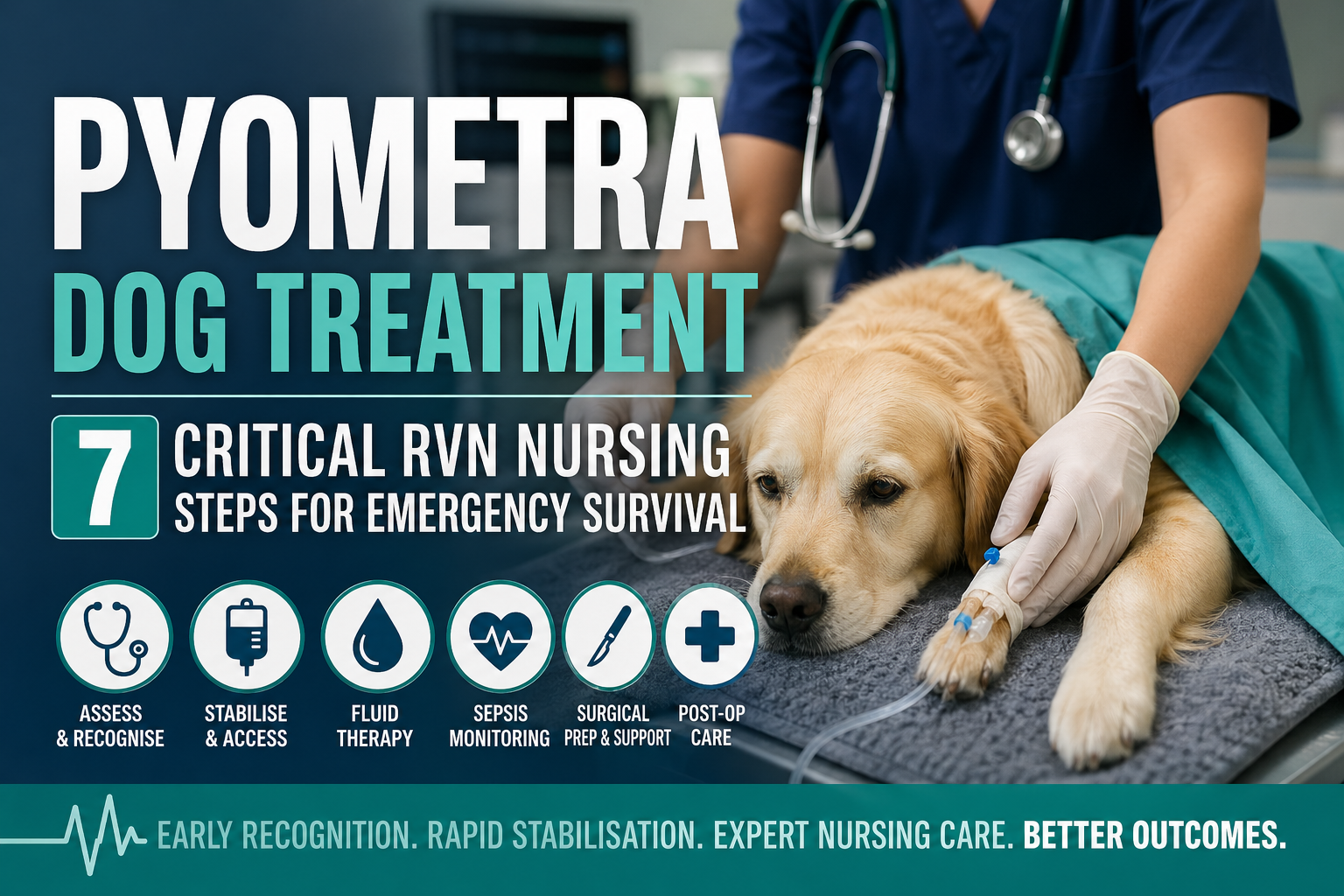

Pyometra is a life-threatening uterine infection in entire female dogs and one of the most urgent surgical emergencies seen in small animal practice. Effective pyometra dog treatment depends heavily on rapid veterinary intervention and, crucially, skilled veterinary nurse support throughout stabilisation, surgery, and recovery.
This guide breaks the condition into 7 essential RVN nursing steps for emergency management.
Read also: Emergency Veterinary Nursing: How to Improve Confidence in Practice
1. Emergency Triage and Recognition
First contact assessment is critical in suspected pyometra cases.
RVN priorities:
- Rapid triage (ABC approach)
- Assessment of perfusion: HR, CRT, pulse quality
- Temperature check (may be normal, high, or low in sepsis)
- Identify lethargy, collapse, or abdominal distension
- Check for vulval discharge (if open pyometra)
Closed cervix cases are particularly dangerous as they may present with minimal external signs but significant systemic compromise.
2. Immediate Stabilisation and IV Access
Once suspected, treatment becomes emergency-focused.
Nursing actions:
- Place 1–2 large-bore IV catheters
- Begin controlled fluid resuscitation
- Collect baseline bloods (PCV/TS, biochemistry, lactate if available)
- Initiate continuous monitoring chart
This phase is the foundation of effective pyometra dog treatment, especially in septic or hypovolaemic patients.
3. Fluid Therapy and Perfusion Support
Fluid Therapy is the cornerstone of stabilisation.
RVN monitoring focus:
- Heart rate trends (not single readings)
- Pulse quality improvement
- Mucous membrane colour changes
- Urine output (if measurable)
- Blood pressure where available
Goal: restore perfusion without causing fluid overload, especially in compromised or septic patients.
4. Sepsis Monitoring and Early Warning Detection
Sepsis is a major complication in pyometra, particularly closed cases.
Nursing monitoring includes:
- Serial temperature recordings
- Mentation changes (quiet → obtunded → collapse risk)
- Tachycardia progression
- Lactate trends (if available)
- Capillary refill time changes
Any deterioration requires immediate escalation to the veterinary surgeon.
5. Pre-Operative Preparation and Risk Reduction
Once stabilised, the patient is prepared for emergency ovariohysterectomy.
RVN responsibilities:
- Surgical site clipping and aseptic prep
- Confirm IV fluid continuation pre-induction
- Review blood results for anaesthetic risk
- Ensure active warming (prevent hypothermia)
- Double-check drug calculations and patient weight
These patients are high anaesthetic risk due to systemic illness and potential endotoxaemia.
6. Intraoperative Monitoring and Anaesthetic Support
During surgery, RVNs play a vital role in patient safety.
Key duties:
- Continuous monitoring (HR, BP, SpO₂, ETCO₂ if available)
- Fluid rate adjustments under veterinary direction
- Blood loss estimation and communication
- Temperature management (hypothermia prevention)
- Instrument and swab counts
Pyometra surgery can be prolonged due to fragile uterine tissue and risk of rupture.
7. Post-Operative Critical Care and Recovery Monitoring
Post-surgical care is often the most overlooked but vital stage of pyometra dog treatment.
RVN priorities:
- Frequent vital sign monitoring (15–30 min initially)
- Pain scoring and multimodal analgesia support
- Continued fluid therapy as required
- Wound monitoring for infection or dehiscence
- Urine output and renal perfusion assessment
Watch closely for:
- Persistent tachycardia (pain or sepsis)
- Hypotension rebound
- Acute kidney injury
- Ongoing systemic inflammatory response
Diagnostic Workup and Clinical Decision-Making in Pyometra Dog Treatment
A critical part of pyometra dog treatment is the diagnostic confirmation phase, where veterinary nurses play a key supporting role in gathering samples, stabilising the patient, and assisting with imaging and laboratory interpretation.
While pyometra is often suspected based on history and clinical presentation, definitive diagnosis relies on a combination of clinical pathology and imaging findings. RVNs are frequently responsible for preparing the patient, assisting with diagnostics, and ensuring results are processed efficiently in what is often a rapidly deteriorating emergency case.
Haematology and Biochemistry Support
Blood work is essential in guiding severity assessment and treatment planning. Common findings in pyometra cases include:
- Neutrophilia with a left shift
- Possible toxic changes in neutrophils
- Elevated inflammatory markers
- Evidence of dehydration (increased PCV/TS)
- Azotaemia in more advanced cases
RVNs play a vital role in:
- Efficient venepuncture assistance or sample collection
- Accurate labelling and prioritisation of urgent samples
- Rapid in-house analyser use where available
- Communication of critical results to the veterinary surgeon
These findings help determine whether immediate surgical intervention is required or whether short-term stabilisation is necessary before proceeding.
Imaging and Diagnostic Assistance
Abdominal imaging is often used to confirm uterine distension and assess severity.
Ultrasonography typically reveals:
- Enlarged, fluid-filled uterine horns
- Echogenic fluid contents consistent with pus
- Possible uterine wall thickening or irregularity
Radiography may show:
- Soft tissue opacity in caudal abdomen
- Displacement of intestinal structures
- Generalised abdominal enlargement in advanced cases
RVNs are frequently involved in:
- Patient restraint and positioning
- Sedation monitoring support if required
- Preparing imaging equipment and maintaining sterility if ultrasound-guided sampling is performed
- Ensuring patient stability during diagnostic delay periods
Clinical Decision-Making and Surgical Prioritisation
Once diagnostic suspicion is confirmed, decision-making for pyometra dog treatment becomes time-critical. The veterinary team must determine whether immediate surgery is required or if short stabilisation is possible.
RVNs contribute significantly by continuously updating the clinical picture through monitoring trends rather than single readings. Deterioration in perfusion parameters, mentation, or cardiovascular stability often prompts urgent escalation.
Key indicators that influence surgical urgency include:
- Evidence of closed cervix pyometra
- Signs of systemic inflammatory response
- Progressive hypotension or poor perfusion
- Rising lactate levels
- Reduced urine output or early renal compromise
In many cases, the RVN is the first to detect subtle deterioration, making structured monitoring charts and consistent reassessment essential.
Team Communication and Workflow Coordination
Effective pyometra dog treatment relies heavily on coordinated teamwork between veterinary surgeons and nurses. RVNs act as the central link between diagnostics, stabilisation, and surgical preparation.
Clear communication is essential when:
- Relaying critical blood results
- Reporting changes in patient status
- Coordinating imaging and pre-operative preparation
- Ensuring timely antibiotic and fluid administration
In busy clinical environments, structured handovers and accurate record-keeping directly influence patient outcomes.
Importance of Nursing Judgement in Outcome
While surgical removal of the uterus remains the definitive treatment, the outcome of pyometra cases is often determined before the patient enters theatre. The quality of stabilisation, speed of recognition, and consistency of monitoring are all heavily influenced by RVN input.
Strong nursing assessment can:
- Reduce anaesthetic risk
- Improve perfusion prior to surgery
- Identify early sepsis progression
- Prevent clinical deterioration during diagnostic delays
Ultimately, successful pyometra dog treatment is not only a surgical achievement but also a reflection of high-quality veterinary nursing care throughout the entire emergency pathway.
Conclusion
Successful pyometra dog treatment relies on rapid recognition, aggressive stabilisation, and coordinated veterinary nurse care throughout every stage of the patient journey.
For RVNs, the key takeaways are:
- Early triage saves lives
- Fluid therapy is central to stabilisation
- Sepsis monitoring is continuous, not intermittent
- Perioperative nursing directly impacts survival outcomes
- Post-operative care is just as critical as surgery
With structured nursing intervention, outcomes for pyometra patients can improve dramatically, even in severe presentations.
Useful link: Pyometra (infected womb) in dogs – PDSA



Leave a Reply