
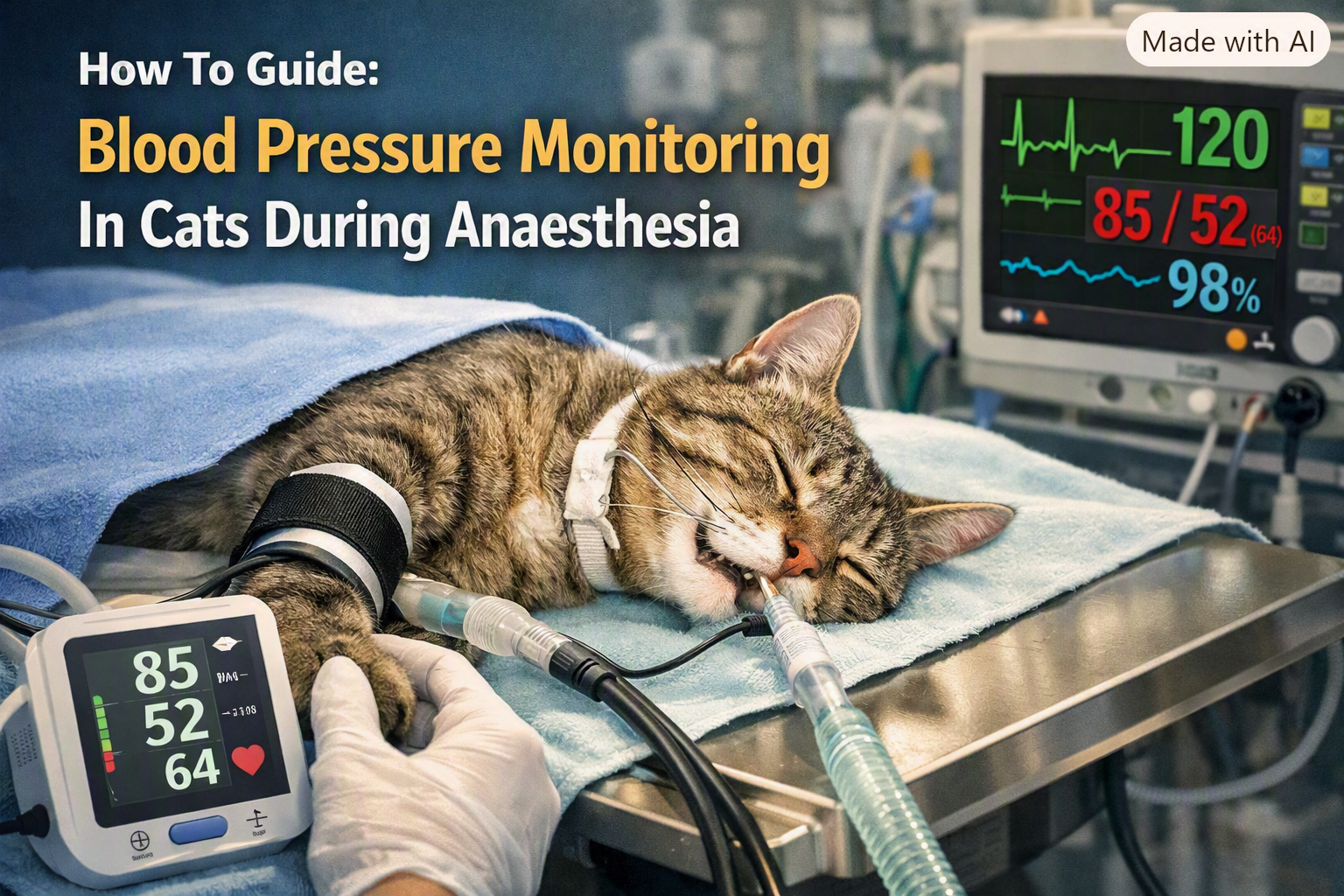

Blood pressure monitoring in cats during anaesthesia is important.
During anaesthesia, changes in cardiovascular function can result in hypotension, which may reduce tissue perfusion and require intervention.
For veterinary nurses, recognising changes in blood pressure, identifying potential causes and communicating trends to the veterinary surgeon are important aspects of safe anaesthetic care.
Blood pressure should never be interpreted in isolation. It should be considered alongside the patient’s heart rate, pulse quality, mucous membranes, capillary refill time, respiratory parameters, temperature, anaesthetic depth and overall clinical picture.
Why monitor blood pressure during feline anaesthesia?
Anaesthetic drugs can affect cardiovascular function in several ways.
Depending on the drugs used, patient factors and surgical procedure, anaesthesia can result in reduced vascular tone, changes in cardiac output and alterations in blood pressure.
A patient may therefore become hypotensive even when other parameters initially appear relatively stable.
Monitoring blood pressure provides an objective measurement of cardiovascular function and helps the veterinary team identify deterioration early.
What blood pressure parameters are measured?
Blood pressure monitors may provide several values:
- Systolic blood pressure (SBP)
- Diastolic blood pressure (DBP)
- Mean arterial pressure (MAP)
MAP is particularly useful when considering overall tissue perfusion during anaesthesia.
However, the reliability of individual measurements depends on the equipment, technique and patient.
In conscious cats, Doppler and high-definition oscillometric techniques are commonly used for non-invasive blood pressure measurement.
How can blood pressure be measured during anaesthesia?
Non-invasive blood pressure monitoring is frequently used during routine anaesthesia.
Depending on the equipment available, this may involve:
Doppler
Doppler blood pressure monitoring can be particularly useful in cats.
A cuff is placed around an appropriate limb or tail, with the Doppler probe positioned to detect arterial blood flow.
As cuff pressure is released, the return of detectable arterial flow is used to determine systolic blood pressure.
Doppler is widely used in feline practice because it can provide useful readings even in small patients.
Oscillometric monitoring
Oscillometric monitors automatically inflate and deflate the cuff and use pressure oscillations to calculate blood pressure.
These monitors can provide SBP, DBP and MAP, although the accuracy of different devices can vary, particularly at extremes of blood pressure.
Whatever equipment is used, following the manufacturer’s instructions and maintaining a consistent technique is important.
Choosing the correct cuff
Cuff size has a major influence on the reliability of blood pressure measurements.
A cuff that is too small may result in falsely high readings, while an excessively large cuff may produce falsely low readings.
Use a cuff appropriate for the measurement site and patient, following the monitor manufacturer’s recommendations.
The cuff should be applied securely without being excessively tight.
For anaesthetic monitoring, it is also useful to ensure that the cuff and tubing can remain in position throughout the procedure without interfering with surgery or patient positioning.
Where should the cuff be placed?
The measurement site depends on the equipment and the individual patient.
Common sites include:
- Forelimb
- Hindlimb
- Tail
The important point is to use a consistent site and ensure the measurement is obtained appropriately for the monitor being used.
Where possible, the measurement site should be positioned at approximately heart level.
If the patient’s position changes substantially during anaesthesia, consider whether this could affect the interpretation of the reading.
How often should blood pressure be monitored?
The frequency of monitoring depends on the patient, procedure and risk factors.
A healthy patient undergoing a straightforward procedure may require less intensive monitoring than a critically ill patient or one with known cardiovascular or renal disease.
During anaesthesia, blood pressure should be assessed regularly rather than relying on a single reading.
Recording readings over time allows the veterinary team to identify trends.
For example, a gradual fall in MAP over several readings may be more clinically significant than one isolated abnormal measurement.
What is hypotension?
Hypotension refers to abnormally low blood pressure.
During anaesthesia, hypotension can potentially reduce tissue perfusion, particularly if it is persistent or severe.
A commonly used anaesthetic concern is a MAP below approximately 60–70 mmHg, although the significance of a particular value depends on the individual patient and clinical context.
The veterinary team should consider the trend and the patient’s other monitoring parameters rather than treating a blood pressure value in isolation.
What can cause hypotension during anaesthesia?
There are several potential causes.
Excessive anaesthetic depth
Excessive anaesthetic depth can contribute to cardiovascular depression and vasodilation.
If blood pressure falls, anaesthetic depth should therefore be assessed.
Hypovolaemia
Patients with reduced circulating volume may be more susceptible to hypotension.
Possible causes include:
- Blood loss
- Dehydration
- Fluid losses
- Inadequate circulating volume before anaesthesia
Drug effects
Anaesthetic and analgesic drugs can influence vascular tone, heart rate and cardiac output.
The drugs administered should therefore be considered when investigating a change in blood pressure.
Cardiovascular disease
Underlying cardiac disease can also contribute to poor cardiovascular performance under anaesthesia.
This is particularly relevant when anaesthetising older cats or patients with known cardiac abnormalities.
What should you do if blood pressure falls?
If a cat becomes hypotensive during anaesthesia, the veterinary team should assess the patient systematically.
Consider:
1. Check the reading
Make sure the cuff is correctly positioned and appropriately sized.
Check the tubing and connections and repeat the measurement if necessary.
2. Assess anaesthetic depth
Determine whether the patient may be deeper than necessary.
The veterinary surgeon may decide whether adjustments to the anaesthetic protocol are appropriate.
3. Assess cardiovascular parameters
Look at:
- Heart rate
- Pulse quality
- ECG where available
- Mucous membranes
- Capillary refill time
- Blood pressure trend
4. Consider circulating volume
Assess whether hypovolaemia or blood loss could be contributing.
Fluid therapy or other cardiovascular support may be considered by the veterinary surgeon depending on the patient’s condition.
5. Continue monitoring
After an intervention, continue monitoring blood pressure to determine whether the patient responds.
The response to treatment can provide useful information about the underlying cause.
Why trends are more useful than isolated readings
Anaesthetic monitoring is about recognising changes.
For example:
| Time | MAP |
|---|---|
| 10:00 | 78 mmHg |
| 10:15 | 72 mmHg |
| 10:30 | 65 mmHg |
| 10:45 | 57 mmHg |
The final reading is important, but so is the trend.
A progressive decline suggests that cardiovascular status may be changing and should prompt assessment rather than waiting for the blood pressure to fall further.
This is one reason accurate and consistent documentation is so important.
Common blood pressure monitoring mistakes
Using the wrong cuff size
This can produce misleading readings.
Changing the measurement site
Readings from different sites may not be directly comparable.
Taking only one reading
A single measurement may not represent the patient’s blood pressure accurately.
Ignoring equipment problems
Before responding to an unexpected reading, check the cuff, tubing, connections and monitor.
Focusing on blood pressure alone
Blood pressure is only one component of anaesthetic monitoring.
Always interpret it alongside the rest of the patient’s clinical parameters.
Blood pressure monitoring in high-risk cats
Some cats may require particularly close cardiovascular monitoring.
This can include patients with:
- Renal disease
- Cardiac disease
- Significant dehydration
- Blood loss
- Sepsis
- Previous anaesthetic complications
- Advanced age
- Significant systemic disease
The anaesthetic plan should be tailored to the individual patient and procedure.
Recording blood pressure during anaesthesia
Good documentation should allow another member of the veterinary team to understand how the patient’s blood pressure changed throughout the procedure.
Depending on practice protocol, record:
- Time
- SBP
- DBP where available
- MAP
- Measurement site
- Equipment
- Patient position
- Relevant interventions
This is particularly useful if hypotension occurs.
A record showing a progressive fall in blood pressure can help the veterinary team understand when the problem began and how the patient responded to intervention.
The veterinary nurse’s role
Veterinary nurses are often responsible for obtaining and documenting anaesthetic monitoring parameters.
This makes understanding blood pressure particularly important.
The nurse should be able to recognise an unexpected reading, check the equipment and patient, identify a concerning trend and communicate changes promptly to the veterinary surgeon.
Good monitoring is not simply about recording numbers.
It is about recognising what those numbers mean in the context of the individual patient.
Frequently asked questions
What MAP is too low in an anaesthetised cat?
A MAP below approximately 60–70 mmHg is commonly considered concerning during anaesthesia, but the appropriate threshold depends on the individual patient and clinical situation.
Can anaesthetic drugs cause low blood pressure?
Yes. Anaesthetic drugs can alter vascular tone, cardiac output and cardiovascular function, potentially contributing to hypotension.
Is Doppler good for cats?
Doppler is a commonly used non-invasive method for measuring blood pressure in cats and can be particularly useful in small patients.
How often should I check blood pressure during anaesthesia?
The frequency should reflect the patient’s risk, procedure and practice protocol. Regular repeated measurements allow trends to be identified rather than relying on a single reading.
Why is MAP important?
MAP provides an indication of the average pressure driving blood through the systemic circulation and is therefore useful when assessing cardiovascular status during anaesthesia.
Final thoughts
Blood pressure monitoring is an important part of feline anaesthetic monitoring.
The key is not simply knowing whether a reading is high or low, but recognising changes, checking the reliability of the measurement and interpreting blood pressure alongside the rest of the patient’s clinical parameters.
For veterinary nurses, consistent technique, accurate documentation and early recognition of hypotension can all contribute to safer anaesthetic monitoring.
For a detailed guide to obtaining the measurement itself, read:
How to Take Blood Pressure in Cats: A 4-Step Veterinary Nurse Guide.




Leave a Reply