
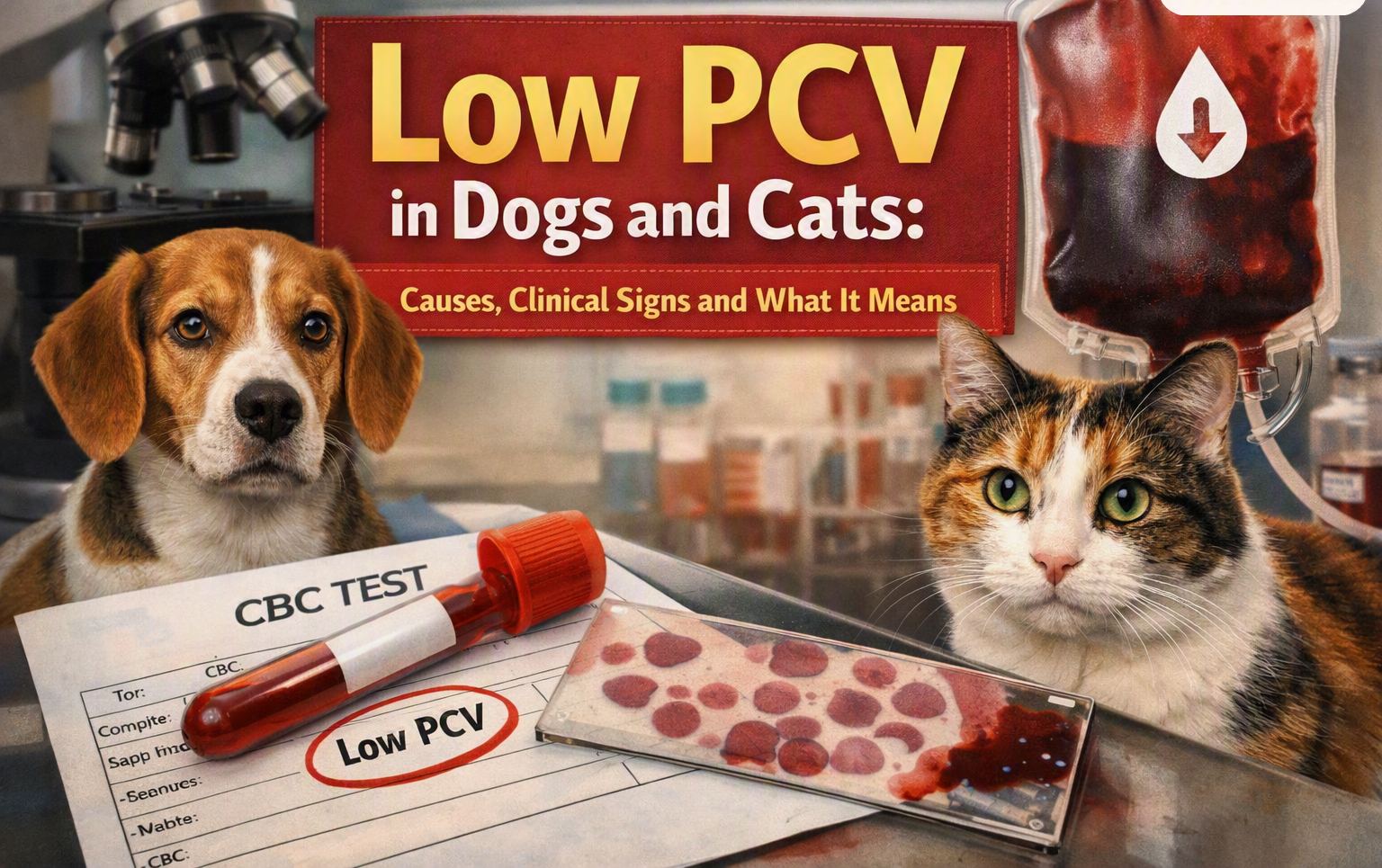

Seeing a low PCV in dogs on a blood result can immediately make you think anaemia.
And that’s a reasonable place to start.
But a low PCV is a finding, not a diagnosis.
There are several reasons a dog or cat can have a low PCV, and working out the underlying cause requires looking at the whole clinical picture.
If you’re carrying out a manual PCV, take a look at our post 7 Essential Facts About Manual PCV Every Veterinary Nurse Should Know
What is a low PCV?
A low PCV means that the proportion of blood made up of red blood cells is below the relevant reference interval.
Because red blood cells carry oxygen around the body, significant reductions can affect tissue oxygen delivery.
The severity depends on how low the PCV is, how quickly it has fallen and how well the patient is compensating.
A slowly developing anaemia can sometimes be surprisingly well tolerated.
A rapid fall, on the other hand, can be much more clinically significant.
Wondering what a high PCV means? Take a read of High PCV in Dogs and Cats: 7 Causes Veterinary Nurses Should Know
Common causes of low PCV in dogs
When investigating a low PCV in dogs, the major categories to think about are:
- Blood loss
- Red blood cell destruction
- Reduced red blood cell production
- Haemodilution
These categories can overlap.
Blood loss
Blood loss is an obvious cause of a low PCV.
This could be:
- Trauma
- Surgery
- Gastrointestinal bleeding
- Internal haemorrhage
- Parasites
- Urinary tract bleeding
- Chronic blood loss
Acute haemorrhage can be particularly deceptive.
Immediately after significant blood loss, the animal may lose whole blood, meaning the initial PCV isn’t necessarily as dramatically low as you’d expect.
As fluid shifts from the tissues into the vascular space, the blood becomes more diluted and the PCV can fall.
Red blood cell destruction
Another possibility is haemolysis.
Here, red blood cells are being destroyed faster than the body can replace them.
Potential causes include immune-mediated disease, certain toxins, infectious diseases and other conditions affecting red cell survival.
Other laboratory findings may help support the suspicion of haemolysis.
Reduced production
The bone marrow is responsible for producing red blood cells.
If production decreases, the circulating red cell population can eventually fall.
Possible causes include chronic disease, bone marrow disorders, renal disease and nutritional or hormonal influences.
The patient’s history and additional blood results are important here.
Haemodilution
Not every low PCV means the patient has lost red blood cells.
Fluid therapy can dilute circulating blood.
For example, a patient may have a higher PCV when first admitted while dehydrated, followed by a lower PCV after receiving IV fluids.
That’s why knowing what treatment the patient has received is essential.
Clinical signs of anaemia
The signs associated with a low PCV vary according to the severity and speed of onset.
Possible signs include:
- Pale mucous membranes
- Weakness
- Lethargy
- Exercise intolerance
- Increased heart rate
- Increased respiratory rate
- Tachypnoea
- Collapse
- Reduced appetite
Severely anaemic patients may show obvious signs of poor oxygen delivery.
However, don’t rely on mucous membrane colour alone.
A patient can have anaemia without dramatic pallor, particularly early in the process.
Acute versus chronic anaemia
This distinction is really important.
A patient that suddenly loses a large volume of blood may become critically unwell very quickly.
Another patient may have a much lower PCV but remain relatively bright because the anaemia developed gradually and the body has had time to compensate.
This is why the PCV should never be interpreted without considering the history.
Looking at the trend
If you’re monitoring a patient with a low PCV in dogs, one of the most useful things you can do is look at previous results.
For example:
Day 1: 38%
Day 2: 32%
Day 3: 25%
That downward trend is much more informative than simply knowing the current PCV is 25%.
The direction and speed of change matter.
PCV and total solids
Total solids can provide additional information.
A low PCV combined with low total solids may be consistent with blood loss in some circumstances.
A low PCV with normal or increased total solids may point towards a different clinical picture.
This isn’t a diagnostic shortcut, but it can help veterinary teams decide what other information is needed.
What can veterinary nurses monitor?
Veterinary nurses play an important role in monitoring patients with a low PCV.
Depending on the patient and practice protocol, monitoring may include:
- Mucous membranes
- Heart rate
- Respiratory rate and effort
- Mentation
- Temperature
- Pulse quality
- Capillary refill time
- PCV trends
- Total solids
- Urine output
- Appetite
- Evidence of ongoing blood loss
Any deterioration should be escalated appropriately.
When is a low PCV an emergency?
The number alone doesn’t determine whether a patient is an emergency.
A patient with a moderately reduced PCV but stable clinical signs may be managed very differently from a patient with rapidly falling PCV, active haemorrhage and signs of cardiovascular compromise.
The speed of change and clinical status are key.
Final thoughts
A low PCV in dogs is a finding that should prompt questions rather than immediately give you an answer.
Has the patient lost blood?
Are red cells being destroyed?
Is production reduced?
Could haemodilution be contributing?
And most importantly, what is the patient actually doing?
For veterinary nurses, serial PCVs can be incredibly useful because they allow you to see where the patient is heading rather than relying on one isolated number.






Leave a Reply